Case Study · Design Management
Personalized Goal-Driven Onboarding
- Role
- Design Manager, cross-functional lead
- Context
- Experian Consumer Services
- Year
- 2023 - 2024
The problem
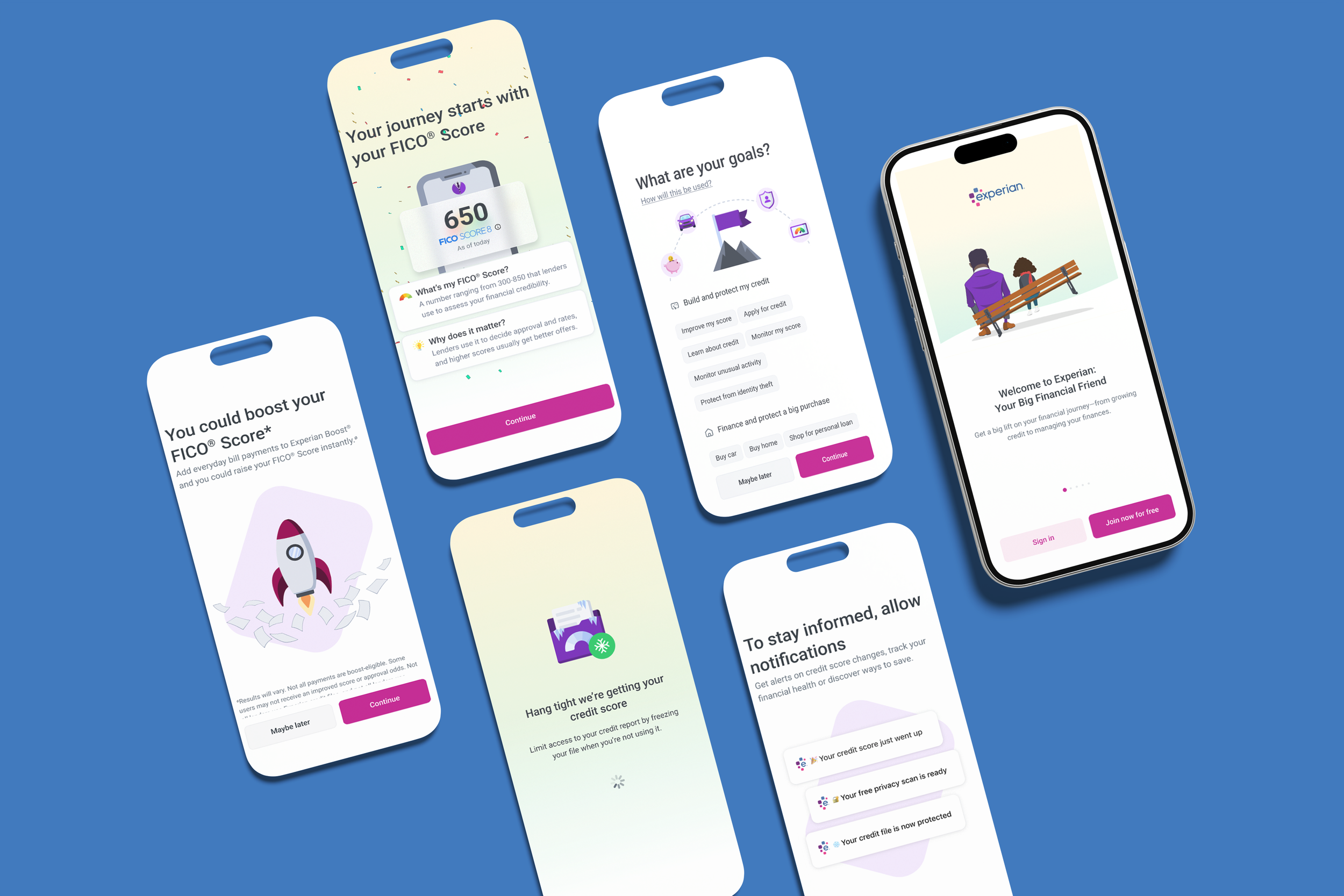
Experian's consumer onboarding was one-size-fits-all: a linear intake that treated a user optimizing a credit score the same as a user shopping for a loan. Drop-off happened before users understood what the product could do for them, and downstream engagement paid for it. I made the call that onboarding needed to be treated as a growth surface, not a form - and set the direction for a more fluid experience that got users instantly to what they came for, while baking in credit education along the way instead of front-loading it as a separate step.
What I led
My role
I led a team of three designers across this initiative, end to end - discovery, strategy, and delivery. I set the design direction (segment by intent, deliver value early, defer friction), ran weekly critiques to keep the team aligned as the flow evolved, and served as the primary design voice in front of PMs, engineers, content, and executive stakeholders. I coached the two designers on my team through a high-visibility initiative - giving direction on flow structure while pushing them to own the rationale behind their decisions when presenting to stakeholders, not just the screens.
I stayed hands-on in the critical flows myself, particularly the initial goal-selection moment and the branching logic that followed it, because that's where the whole strategy either worked or didn't.
Designing within a new technical constraint
We were building this on server-driven UI (SDUI), a development approach that was new to our engineering org at the time. As the component libraries were still being built out, I made the call to adapt parts of the design to what the new SDUI libraries could actually support, rather than hold out for pixel-perfect fidelity. That meant simplifying some branching interactions and working closely with engineering earlier than I normally would, so the design system and the new technical foundation matured together instead of the design outrunning what could ship.
Deferring friction against business pressure
The instinct on the business side was to front-load data collection and product education early, while attention was highest. I pushed to defer that friction instead - get users to their stated goal first, and layer in credit education and account setup after they'd already found value. That was a bet against the standard onboarding playbook, and it meant defending a slower path to some business metrics in exchange for a stronger activation signal downstream.
Spending political capital on onboarding as a growth lever
Onboarding wasn't seen as a strategic investment before this - it was a solved problem nobody revisited. I made the case to executive stakeholders that it was actually the highest-leverage place in the product to invest, and framed the trade-offs so the team could ship with real conviction instead of shipping around competing opinions.
The personalization layer
This wasn't a static flow with a few branches bolted on - it was goal-driven by design. During discovery, we identified distinct user motivation profiles (a user optimizing a credit score behaves very differently from one shopping for a loan) through journey mapping and research, and mapped the onboarding experience to those profiles rather than to a single generic path.
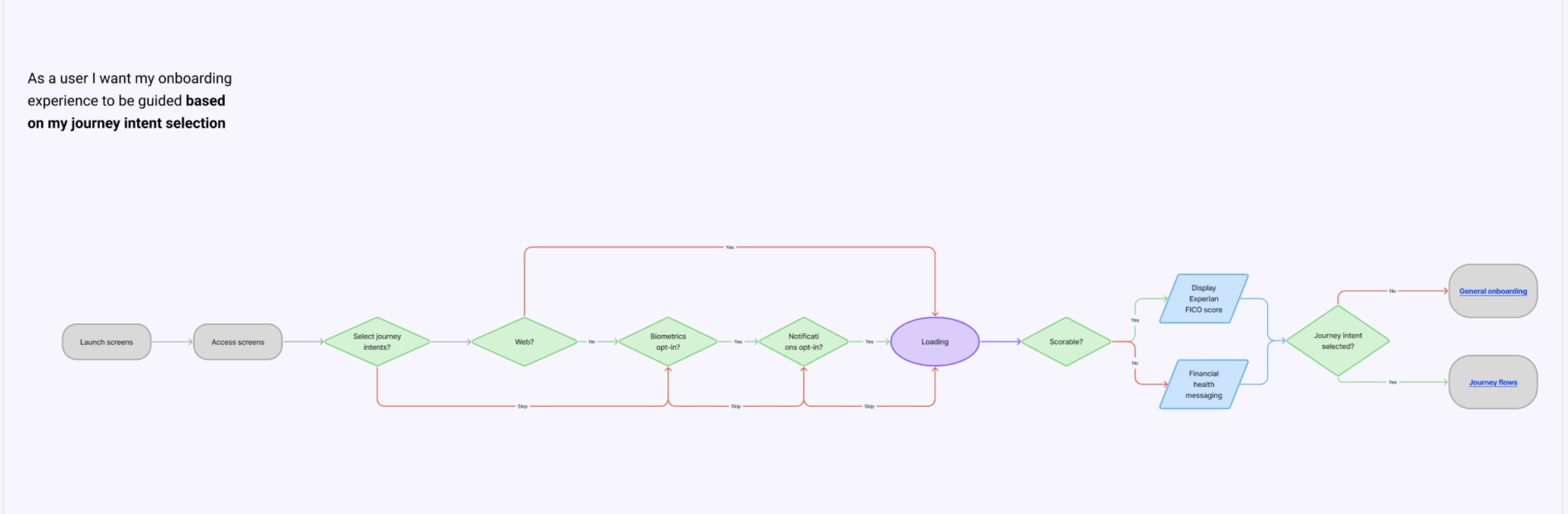
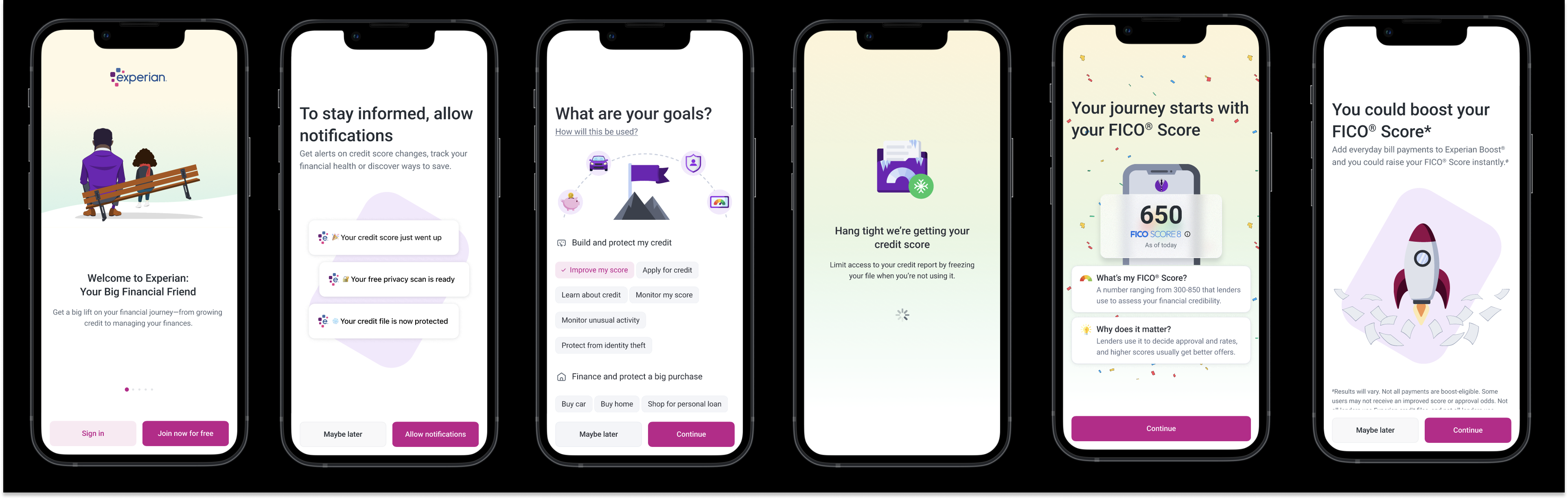
The experience adapted dynamically to each user's stated goal at intake, surfacing relevant features and content and skipping what wasn't relevant to them - reducing cognitive load while increasing activation for each segment. It's rule-based personalization rather than machine-learned, but the underlying discipline is the same: use what you know about a user's intent to decide what they see next.
I designed the goal taxonomy and the branching logic to be extensible on purpose, not as an afterthought - a foundation that could eventually support algorithmic routing as usage data matured, rather than a one-off flow that would need to be rebuilt from scratch to get there.
Outcome
↑↑
Measurable lifts in early engagement and per-user revenue
The decision to segment onboarding by user-stated goals - rather than defaulting to standard feature education - drove measurable lifts in early engagement and per-user revenue. That result was the direct payoff of the trade-off I made to defer friction and delay some business-facing data collection in favor of getting users to value faster.
Just as important as the metrics: the org now understands onboarding as a growth lever, not a UX problem to solve once and shelve. The pattern we established - segment by intent, deliver value early, defer friction - continues to shape how downstream features are scoped and designed, well beyond the original initiative.
Gallery
Reflection
The goal taxonomy and behavioral signals we established during this project are the data foundation for an eventually algorithmic routing layer - the next evolution isn't a redesign, it's teaching the system to refine those segments itself as more usage data comes in.